Showing posts with label water. Show all posts

Tuesday, April 1, 2014

Tap, Tap, Tap

Have you heard about the Tap Project?

It's an ingenious idea.  UNICEF is working to help the 768 million people around the world without access to clean water. This year you can help by taking a challenge to give up access to something far less vital than water–your cell phone.

You are challenged to give up your cell phone.  You register your cell phone, put it down and don't touch it, for as long as you can go.  For each 10 minutes you don't touch your phone, you can give a day's fresh water to someone without access to it.

I don't know how it works and who the people are who are supplying the funds to bring fresh water to people in need, but I thought...what the heck.  I have a cell phone that goes for days at a time without being used for anything important.   As of the last moment I checked, people participating in the project have donated the equivalent of 4.5 years of clean water

It does mean not only no phone calls or text messages, but no selfies, no Instagram, no Word with Friends. I can do without that for a day or so to bring fresh water to people without it.

Almost every profile I read of children waiting for Compassion sponsors includes among their household chores "carrying water."  Some of my sponsored children carry water over a mile twice a day so that their families can have water to cook with and wash with...and those water sources are not necessarily safe water sources.

The farthest I carry water is when I fill a pint sized glass and carry it all. the. way. across the family room to the recliner, where I drink it while I watch television.

Many of the daily blog entries for Compassion concern water.
Little-Girl_Water-Jug.jpg (29312 bytes)The walk from Isabel’s home to the river took about 30 minutes. The view of the river was stunning, and most of the walk was down a very steep slope.

Upon reaching the river, I found a wash house where people gather to bathe. This is also where a pavilion is set up to wash clothes.

We learned that this water, like most water in the developing world, is contaminated and a cause of illness to the families who rely on it.

We filled our five-gallon water jugs from the river and, with each jug now weighing about 40 pounds, began trudging back up the hill to Isabel’s home.

Isabel placed her jug on her head and slowly but steadily walked up the steep path. The men in our sponsor group slung their jugs to their shoulders, while the women worked in pairs to lug the heavy jugs up the hill (which, with each step, seemed more like a mountain).

Finally, one of the women in our group tried carrying her water jug on her head. As I struggled up the hill, it seemed insane to place such a heavy jug on my head – especially without a pad like the local women use. But after my friend found this method easier, I decided to follow her example. Indeed, the jug was hard and heavy, but this was definitely easier than anything else I had tried.

I was able to slowly, steadily, step-by-step, make it the rest of the way to the top of the hill. When we finally reached Isabel’s house I had a real feeling of accomplishment, having contributed to the effort of bringing water to this family’s home. We all had a new understanding of walking in the footsteps of the poor, and a new appreciation of their daily task of fetching water.

So much time and energy is spent each day by Isabel and her children just doing what they must to survive. Gathering water and obtaining food is the main task of each day. There is little time or energy, let alone financial resources, to spend on school work or economic tasks such as developing a business.

If, instead of spending hours each day gathering water, these families were able to get water in only a fraction of that time, and if that water were clean rather than a cause of illness, just think of the difference it would make in their lives!

How much different would our lives be if we had to spend two to four hours each day just getting water to cook and do dishes?
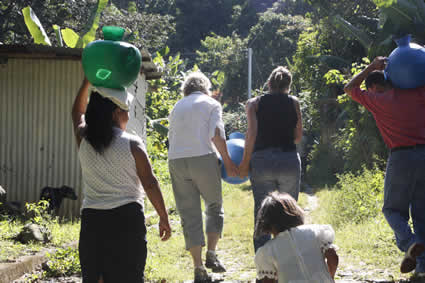
Carrying-Water.jpg (40169 bytes)
I figure if I can do anything to help, if it means giving up Word with Friends or Selfies for a day or so, that's not so bad.

I first started the app running and within 2 hours, my battery had died...apparently the phone needs to be running all the time.  So I plugged it in and it has been going for more than 13 hours now, which is nearly 80 days of fresh water. I don't know how long I'll stay connected to the Tap site, but even if it's only for one day, when I sit down and drink my pint of fresh bottled ice water, I won't feel quite so guilty about walk my sponsored children are making to bring water to their homes tomorrow.

If you feel you can go without touching your cell phone for 10...20...30 minutes...an hour or more, I urge you to check out The Tap Project and see how many days you can provide for children in countries without the access to water that we have.

Friday, July 22, 2011

Water

I put the large glass under the spigot of our water cooler and I pulled the handle. I frequently go to the cooler to get a tall, cold glass of water.

As the water poured out into my glass, one of those big water bubbles popped up inside the big bottle and settled with a loud "plop" on the top. I smiled. It's a fun sound.

I looked at the big bottle and saw that it was almost empty. I would have to go outside and get one of the new bottles that the water man had left for us earlier this week. I always know when the water man has come because the dogs go crazy. I check to see why they are barking and here is this very nice man with a bottle of water on his shoulder, another in his hand, bringing them across the street to my front door.

The 5 gallon bottles are heavy, but they are easier to lift now that they have added handles to the design.

I don't carry the bottle all the way into the kitchen. I lift it up to the floor of the hall and then push it down the hall to the kitchen. Then I lift it up onto the counter, wipe off the dust that has settled on the bottle while sitting outside waiting for me. Then I peel back the label and turn the bottle upside down and stick the bottle on the little spigot that sticks up inside the cooler.

It used to be more difficult to put the water on the cooler, since it involved the possibility of spilling water all over the floor. But they they invented this method which removes any danger of losing water if the bottle slips out of your hands.

I'm really good at changing the water bottle. It's the one physical thing I do that I am good at. I drink so much water that when I began working in offices that had water coolers, I took over keeping the cooler full so that I always had icy cold water to drink.

* * *

It's morning and I'm getting ready for the day. I go into the bathroom and get my fancy electric toothbrush. I turn on the water and put paste on the brush, then I stand there letting the toothbrush brush my teeth for me. At some point I realize how much water has been running freely down the drain and I feel guilty about wasting water, so I turn the faucet off, finish brushing my teeth, then turn the water on again, rinse the toothbrush and put it back. Upstairs, I hear Walt flushing the toilet and the sound of the shower running. I go back to the kitchen and turn on the dishwasher.

* * *

Sheila is out in the back yard licking water out of a bowl that has collected run-off from the sprinkler. The water is brackish. "Yuck," we say. "You don't want to drink that." We empty the bowl onto the grass and refill the bowl with clean water.

* * *

The paperwork for my newest Compassion child, Emanuella, arrived yesterday. I smiled when I read her information. One of her household chores involves carrying water. "They all carry water," I thought to myself.

Well, duhhh...they all do carry water...

There was a diary entry from Compssion yesterday about water. It's entitled "How Far Would you go to fetch safe drinking water?" The writer had recently visited her sponsored child in El Salvador and decided to join the youngest child in the family on her walk to the river to get water.

Little-Girl_Water-Jug.jpg (29312 bytes)The walk from Isabel’s home to the river took about 30 minutes. The view of the river was stunning, and most of the walk was down a very steep slope.

Upon reaching the river, I found a wash house where people gather to bathe. This is also where a pavilion is set up to wash clothes.


We learned that this water, like most water in the developing world, is contaminated and a cause of illness to the families who rely on it.


We filled our five-gallon water jugs from the river and, with each jug now weighing about 40 pounds, began trudging back up the hill to Isabel’s home.


Isabel placed her jug on her head and slowly but steadily walked up the steep path. The men in our sponsor group slung their jugs to their shoulders, while the women worked in pairs to lug the heavy jugs up the hill (which, with each step, seemed more like a mountain).


Finally, one of the women in our group tried carrying her water jug on her head. As I struggled up the hill, it seemed insane to place such a heavy jug on my head – especially without a pad like the local women use. But after my friend found this method easier, I decided to follow her example. Indeed, the jug was hard and heavy, but this was definitely easier than anything else I had tried.


I was able to slowly, steadily, step-by-step, make it the rest of the way to the top of the hill. When we finally reached Isabel’s house I had a real feeling of accomplishment, having contributed to the effort of bringing water to this family’s home. We all had a new understanding of walking in the footsteps of the poor, and a new appreciation of their daily task of fetching water.


So much time and energy is spent each day by Isabel and her children just doing what they must to survive. Gathering water and obtaining food is the main task of each day. There is little time or energy, let alone financial resources, to spend on school work or economic tasks such as developing a business.


If, instead of spending hours each day gathering water, these families were able to get water in only a fraction of that time, and if that water were clean rather than a cause of illness, just think of the difference it would make in their lives!


How much different would our lives be if we had to spend two to four hours each day just getting water to cook and do dishes?

How we take for granted our easy access to water and how little we think of the millions of the people who, along with their small children, are walking 30 minutes or more each day to gather contaminated water so that they can wash, cook, and clean up.

Thursday, February 3, 2011

H2O

Water. A substance essential to humans and other life forms. Without water, plants die. There would be no coffee or jello or Kool-aid. We could not live without water.

Yet, you are constantly hearing people say things like "I know I should drink more water, but I just never remember to do it." or "I try to drink water, but I just can't..."

I have a friend like that. For many, many years her "breakfast" was a super large cup (a quart size) of Pepsi that she picked up at 7-11, and a few cigarettes.

Gulp.jpg  (17901 bytes)

She still drinks lots of Pepsi, but she is happy to have found the 4 oz size bottle of water because if she works at it for several hours, she can finally finish it all. The 8 oz size bottle of water intimidated her and she would never start drinking it because she knew she couldn't finish it.

Drinking water has never, ever been a problem for me.

From a very early age, I loved going to visit my grandmother for one particular reason. She had an ice box built into the wall of her kitchen and in the ice box you could always find a half gallon bottle of water and a glass frosty with precipitation from the moisture in the ice box.

I loved getting water out of that bottle and would make many trips to the kitchen over the course of a visit to get ice water. The icy cold glass made it even more delicious.

I don't remember if we had water in our refrigerator at home and, to tell you the truth, I have no memories of drinking at lot of water in our house, but I loved that water from Nannie's kitchen.

I also remember stopping along the road on the way to visit my other grandmother in Inverness. This was long before highways and this stretch of narrow 2-lane road through Samuel P. Taylor park had a place where you could pull over under the canopy of trees and get a scoop of water running down the side of the mountain into a little basin that had been cut out of the rock. Fresh, clean water straight from the source. It was one of the parts of that long trip that we all looked forward to.

Over the years, I have continued to enjoy water. There was a period of a few years when we first moved to Davis when I almost stopped drinking water because Davis water has a unique taste that I just couldn't learn to like. (David, all the years he was alive, complained about water anywhere else, because he had grown up on "Davis water." Everything else for him tasted like "San Francisco water" and he hated San Francisco water. Which proves, I guess, that our best tastes are the ones we learn to enjoy in our early years.)

The reason Davis water tastes so bad is two-fold. For one thing, the water coming into Davis comes from the Vaca Mountains and has a high boron content. The mineral content is so high that you need to have a water softener to prevent corrosion of the pipes, so everything that comes out of the tap has been filtered through water softener salt and it just leaves a bad taste.

But when we moved here, I decided that if I was going to learn to live in this town, I would have to learn to like its water.

I never did. And I finally decided that the only solution for me was to buy one of those water coolers and drink bottled water.

There has been much discussion about bottled water and how it is ridiculously expensive--significantly more, per gallon, than the gasoline we all complain about. Yet supermarkets devote an entire aisle to types of bottled water. Which mountains they come from, which filters they have gone through, which has the prettiest picture on the bottle, etc.

In truth, I drink bottled water for one reason only: I like the taste. I don't care if it comes from France or the creek up the road apiece. If it tastes as good as the water that came out of the bottle in my grandmother's ice box, I'll drink it. Don't give it a fancy flavor or carbonation or some sort of weird ingredient that will give it extra zest. Just plain old ordinary water is what I want. I keep a big flat of our local supermarket's finest (and cheapest) water in the car, and replace it when it is gone. It's particular good on winter mornings when it is as cold as a bottle fresh out of the fridge.

My recent trip to France and Italy proved that money is no object if I'm thirsty. I don't know how much, total, I paid for bottled water on our trip, but I'm sure it was more than all souvenirs and gelato combined. Yet when you are dying of thirst, you don't stop to bargain with the guy who has water to sell.

At home I drink a lot of water. I drink water with my breakast, and then switch to coffee. I drink water throughout the day. I drink water with lunch and dinner. I take a bottle of water to put beside me to drink if I wake up in the middle of the night. Drinking the recommended 8 glasses of water is never a problem for me.

The glass of water I drink when I go to get a drink of water, is about 8 oz in size. Sometimes I drink two of them because they just taste so good and feel so good going down.

The nice thing about my addiction to water is that it's about the only thing edible to which I'm addicted which is not bad for my health. My doctor may warn me about carbohydrates or sweets, but she never has to remind me to drink more water.