Showing posts with label Mikado. Show all posts

Monday, August 8, 2016

The Town of Tirmisu


Gilbert and Sullivan wrote 13 operettas.  Of those 13, there are the three biggies --  HMS Pinafore, Pirates of Penzance, and The Mikado.  Of these three, Mikado has always been my favorite.  It was Gilbert Russak's KoKo that made me a Lamplighters fan back in the 1960s.  


Koko was one of the two roles for which Gilbert was best known, so it has always been kind of sacrosanct for me.  When we first saw the show at the old Harding Theater in San Francisco, back in the early 1960s, I just loved it and dragged Walt back time and time again whenever Gilbert was doing the role (they were double cast, so sometimes someone else was playing--we got free ushering tickets). (Ironically it was not until nearly 20 years later that I actually met Gilbert and he ended up being my best friend)

Back in 1884-85, when the show was written, Gilbert & Sullivan had a few hits under their belt and Gilbert wanted to do another, but Sullivan was tired of what he felt was the same formula in each operetta and only agreed to do another one if Gilbert could come up with a new idea.
At that time England was going through a craze of "all things Japanese," as a result of rapidly increasing European trade with Japan.  He had already completed the first act of Mikado when an exhibition of all things Japanese opened in Knightsbridge and as they were going into rehearsals, Gilbert invited some of the ladies from the Knightsbridge exposition to come to help the cast of his Mikado to get all the proper gestures and mannerisms right.

For more than 100 years, The Mikado has enjoyed world wide popularity (in 1888 at least 150 companies all over the world were producing it).  It has been performed for at least two Japanese emperors visiting England (one of whom requested it) and was performed in Japan many times.
However, times have changed.  We live in times of political correctness and the show has come under growing criticism by the Asian-American community for promoting "orientalist" stereotypes.   In 2014 a production in Seattle was attacked by a newspaper as "yellowface...in your face."  A year later there was such a firestorm about an upcoming production by the New York Gilbert & Sullivan players that they withdrew it altogether.  Similar complaints have had similar results all over the country.

When two local Asian-American theater companies threatened to picket every performance of the Lamplighters upcoming production, the Yerba Buena Center for the Arts, the Lamplighters San Francisco home for many years, threatened to cancel their lease.

At first the company made an outreach to the Asian American acting community, inviting them to audition for the show, but not enough people showed up to fill a cast of 40 and those who were interested apparently did not want to be in a production that also had Caucasians in "yellowface."  (Ironically, I remember a production of Brigadoon that Walt and I saw decades ago which was put on by the Chinese Cultural Center, where every single Scott in the show was Chinese)

The Lamplighters had to do something.  They came up with the idea of setting the story in Italy (Milan, since the opening song goes "We are gentlemen of Japan" and "We are gentlemen of Milan" fits perfectly), and making minimal changes to the libretto (as it turns out only about 1-2% of the libretto was changed) and set it in the town of Tirmisu (instead of Titipu) during the period of the Renaissance, which gave the opportunity for opulent non-Japanese costumes.


They changed character names:  The Mikado became "Il Ducato, the Emperor of Milan"; his son Nanki-Poo becomes Niccolu (the only name I really didn't like). Koko is now Coco; Pooh Bah, the Lord High Everything is now Pooba; Pish Tush the other nobleman is Piccia Tuccia.  Nanki-Poo is in love with Yum Yum, who is now Amiam, The Mikado's two wards, Pitti Sing and Peep Bo are now Pizzi and Pippa and the gorgon who is in love with Nanki-Poo who was once Katisha is now Catiscia.  Except for Niccolu all the names sound so similar to the original that you don't miss the old names.

Best of all Coco, played by the incomparable Lawrence Ewing, did not disappoint.


Shown here with Bill Neil as Pooba...loved him, hated the hat!


There are minimal, minimal changes in dialog.  Anything obviously Japanese was rewritten, but that involved only the opening song, and a couple of chants supposedly in Japanese.  Otherwise it is exactly as W.S. Gilbert wrote it.

The biggest change from the original is in the choreography, which the Lamplighters had been using, pretty much unchanged, for 60+ years.  You expect the 3 little maids to have fans and use them in a specific way.  You expect Koko to carry a big scimitar and things like that. The new choreography is as faithful to Renaissance Italy as the old was to 19th century Japan.  But it really works.

There has been lots and lots of controversy about this production.  Purists (I admit to being one) wanted to boycott.  The two founders of the company didn't think the Lamplighters should bend to the pressure. Ticket sales fell off. 

I originally did not want to see the show, but ultimately decided that I needed to see exactly what they had done to it before condemning it out of hand, and was pleasantly surprised.  All the stuff they did works, setting the story outside of Japan doesn't alter the story at all...and, in fact, when you remove the Japanese setting all those barbs which were aimed at 19th century Britain work even better.  The replacement lyrics and dialog are inspired (the Lamplighters have the most brilliant writers around, they have reverence for the original text and write things that might have been written by W.S. Gilbert himself.)

The changes were minimal. In the original, for example Koko, in describing a supposed execution, says "I seized him by his little pigtail" which was changed to "I seized him by the scruff of the neck..."

I constantly thought, as I watched the show, that for someone who had never seen the original, this would be a fresh new show and they'd love it.  The theater wasn't full, as it should have been for The Mikado and I can only assume it was all those people who don't want anybody messing with their Mikado.

I hope they give it a chance and go with an open mind.  I did and I'm glad that I did.

The ultimate squelch was that in looking over the chorus I realized that there are more Asians in the cast than I have ever seen in a Lamplighter show before!

Monday, August 20, 2012

Here's a Howdy Do

How many times have I seen The Mikado?  I can't even begin to count them.  I first became aware of The Mikado when I read "Marjorie Morningstar."  Marjorie was cast as the title character in her college production by a director who thought that was the leading role.  According to the book, the girl playing KoKo fell apart and Marjorie took command of the stage and saved the show.  I knew nothing about the show at all at that time.

I actually saw it first in the 1960s when The Lamplighters were still performing at the old Harding Theater in San Francisco, in what was then a not very safe neighborhood.  I first saw Gilbert playing KoKo there and was so taken with the character he created that I dragged Walt back to see his performance over and over again.

Then, of course, the rest is history, with my joining Alison and Carolyn to write the first Lamplighters history, becoming best friends with Gilbert, going to all the shows all the time, seeing Mikado over and over again.  Seeing other productions, too, like the touring D'Oyly Carte company, productions at the International Gilbert & Sullivan festival in England, checking out productions on video (like the one by Groucho Marx).  And continuing to attend new Lamplighters productions of the show.

Mikado is my second favorite Gilbert & Sulllivan (Iolanthe is the first), and I am very particular about the person who plays KoKo.  Was Gilbert the greatest KoKo ever?  Probably not.  It's a very subjective decision and I'm sure there are hundreds of wonderful KoKos out there, that others think are "the best" KoKo.  But Gilbert is the standard by which I judge all the KoKos that I see.  

Longtime leading patterman Rick Williams was also a huge fan of Gilbert's KoKo and worked hard to equal it.  And he definitely was a great KoKo, absorbing Gilbert's portrayal and then building on that to make it his own, a role he played several times.  Others have played the role on the Lamplighters stage through the years with varying degrees of success.

I had heard nothing but wonderful things about the latest production, with Lawrence Ewing in the role of KoKo and when Walt asked if I wanted to go, of course I said yes.  I'm always happy to check out a new Mikado.
Aside:  When we went on our trip, someone had agreed (I thought) to review a show for me in my absence.  The show did not get reviewed because the potential reviewer decided that s/he had "nothing new to say about this particular show."  I took exception to that excuse.  IMHO, the role of a critic is not to educate the public about a particular work that has been reviewed to death already by far better critics, but to review the production.   I cannot begin to count the number of times that I have seen The Mikado, and if I were just to review the script, no, there is nothing new I could say about it, but this production was unlike any done at the Lamplighters before, was excellent, and is why I go to shows that I have seen 100 times before...to see how the new production is!
(I had to add that remark because I have not let the reviewer in question know how much I disagree with his/her decision of why not to review a show and I'm still fuming about it!)
But I digress.

Comparing this new production of Mikado to previous Lamplighters productions may not be like comparing apples and oranges, but it could be like comparing oranges and tangerines.  Unmistakably a Lamplighters production, but with noticeable differences.  Tempos a bit slower in places...I am reminded of my very first "celebrity" interview, when I was part of a group of "press" (I was not yet officially "press") interviewing director Mike Leigh, who directed Topsy Turvy.  All of us Lamplighters who saw the movie together at a special screening couldn't understand why he took such v-e-r-y s-l-o-w tempos.  So that was my question--something about the tempos.  Leigh glared at me and snapped "Absolutely accurate." or something like that.  So maybe today's tempos were a blend of Lamplighters upbeat tempos and Sullivan's slower tempos!   I also decided I'd been going to LL shows for too many years when, after two beats on the drum, I realized that it was not Norman Peck, the LLs long-time percussionist!   (To my surprise, even Walt noticed the difference, both in the tempos and in the drummer.)

This is not as broadly comedic as previous productions of this show, though there were a lot of laughs at the re-written List Song, where KoKo lists all the people he would execute, if he had to execute someone.  Traditionally the humor comes from KoKo having a very long list that stretches across the stage.  This time he had an iPad and instead of showing the names on paper, pictures flashed on the subtitle board across the stage as KoKo flicked his finger across the screen of the iPad. 

A lot of places where I am used to hearing big guffaws from the audience were played more low key so that there were barely snickers, yet my favorite part, where KoKo offers his love to Katisha and she turns and roars at him, causing him to cower beneath her as he says "shrink not from me, Katisha" was perfect, unlike too many productions I see which waste this big laugh moment.

shrink.jpg (165764 bytes)

As for Lawrence's KoKo, it was wonderful.  Absolutely nothing like either Gilbert or Rick, but entirely his own, and equally as terrific.  (You may cherish memories of Gilbert Russak’s Ko-Ko, but here comes F. Lawrence Ewing with a wholly different, mercurial, slippery take on the Lord High Executioner-in-spite-of-himself, says Robert Commanday former critic for the San Francisco Chronicle, now writing for San Francisco Classical Voice) This was a slightly more in-control KoKo, a bit smoother, less afraid of his own shadow. Also his moves reflected Lawrence's ballet training. (Ewing’s Ko-Ko was ever so wily and enchanting a con man, with fine delivery of Ko-Ko’s great numbers like the terrific takeoff on the operatic “willow song,” and with sleek moves, really danced. continues Commanday)

So even though this was just one. more. Mikado. it was a great production and I'm so glad we went.

Sunday, February 21, 2010

The Review

I want to write a review, which is odd because the nice thing about last night was that I was going to a show that I didn't have to review. But I guess the nice thing about being a reviewer is that you get to say what you think and somebody listens...and if you have nobody to say it to, it's no fun.

So I'll review the show. It was The Mikado, which you'd think I would not be eager to see because I've seen it a bazillion times and because there is no KoKo like Gilbert, so why bother? (In fact, I sent a text message to Walt about how I didn't like the KoKo in this production and he said he hadn't expected me to. I hope I am a bit more fair than that.)

I went alone. Walt and I had planned to go together, but the night before last he had a call from his sister that their mother had been taken to the hospital. This was around 11 p.m. She had a fever of 104 and Alice Nan was calling from the Emergency Room. At 2:30, he got the call that they had admitted her to the critical care unit.

The next morning was the flurry of activity, trying to get things organized here so he could leave to fly down there. His brother got on the road at 8 a.m. and was driving down. We had tickets for Mikado last night and for a fund raising show on Sunday. I contacted someone to ask if she wanted to join me for Mikado, but she couldn't. I thought of a couple of other people to call, but then I thought of the alternative, having the alone time in the car to listen to my audio book and decided I'd just go alone.

Mikado.jpg (27645 bytes)The production was by L.O.T.S. (Light Opera Theatre Sacramento), which has been around for several years, but which we have never attended. When the company formed it kind of took audience away from the Davis Comic Opera Co., which was still operating at the time. I don't know all the politics involved, but I was never really interested in going there anyway. If I wanted G&S, my druthers were to get it from The Lamplighters.
But the Katisha in this production was being played by Susanna Peeples, daughter of the now-musical director of The Lamplighters and the one-time lead soprano for The Lamplighters. I remember the night Susanna was born, when her father, Baker, was in the orchestra pit for whatever was the current show while mother, Ellen Kerrigan, was in labor at the hospital and how Baker high-tailed it out of the theatre as soon as the curtain came down so he could be there for the birth of his daughter. (I think that was Susanna's birth...it might have been her brother's.)

We didn't really know Susanna at all until she asked us if she could ride with us to a Lamplighters event in SF and I've kind of felt a bit of camaraderie with her ever since. And of course she's a Facebook friend.

Because this isn't a real review, I'm going to leave out names other than Susanna's. Also because I'm too lazy to get up and go get the program.

I don't like driving on the freeway at night, even with my new clear vision and there was a point at which I wished I had just given up and not gone at all, but I mushed on and found the theatre all right. It's a nice venue with comfortable seats and general seating so I could find a place where my knee would be happy and where the people in front of me wouldn't feel they were going to catch the plague from my coughing (which is significantly better, BTW, but still sounds horrible if you haven't heard it before).

My first impression was that the orchestra was surprisingly good. Professionally good. That was a very pleasant thing to discover since so often little theatres in this area who rely on volunteer orchestras leave a lot to be desired and sometimes contain the "wince factor." But this orchestra was going to be good...and the tempos, which sometimes can be funereal, were sprightly and I knew that if Gilbert was watching somewhere in the celestial highlands he wold have approved.

Aside: I once interviewed Mike Leigh, director of "Topsy Turvy," the movie about Gilbert and Sullivan, about the slow tempos in the movie, which all of us in the Lamplighters who had seen a special screening had complained about. He glared at me and barked that they were 100% accurate.

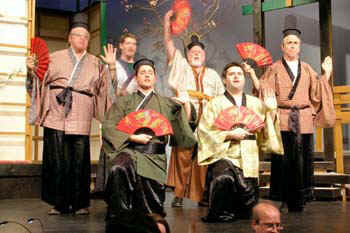
The second thing that impressed me was that with a chorus of only 6 men, they filled the theatre with sound. So often I've seen G&S shows done with small choruses and there is so much lacking, but these guys sang with such volume and confidence that you didn't miss a full chorus.

MikadoMen.jpg (41274 bytes)

The same held true for the women, which was augmented, at least in the early part of Act 1, by Susanna, dressed as a young Japanese woman, not the old Japanese woman she would become by the end of the act.

Pish Tush (also the co-director) was quite good. Pooh Bah was OK, but not outstanding.

KoKo.jpg (23944 bytes)Things were going well until KoKo came on. Now, as I've said earlier in this piece, KoKo is my favorite character and it's very difficult to beat Gilbert's KoKo, but I have seen other KoKos who have been fine. This guy was awful. And I suspect it was more a problem of direction than of ability, because he seemed comfortable on stage and had a nice voice (even Gilbert didn't have a "nice voice.") It also didn't help that he looked like the entertainment editor of the Enterprise with what appeared to be a bunch of unruly black curls on top of his head. Curls on a Japanese man? It was a terrible costuming choice! (He looked better in the publicity photos, when he didn't have anything weird on his head)
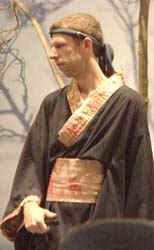
The Mikado was OK, but there was nothing "terrifying" about him. He was just a tall, thin man with funny stuff painted on his face. He should have been larger than life (which is possible to do even if you are very short, as we all learned when John Gilkerson played the role for the Lamplighters!)

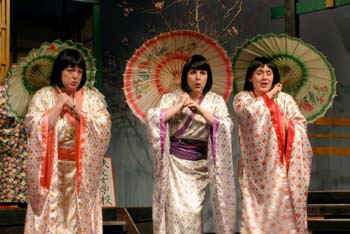
The girls were fine. Both YumYum and PittiSing managed to wring a lot of humor from their lines, which was very good.

KatieBaad.jpg (40420 bytes)

The main problem was in the directing overall. While it looked fine, there was no oomph to it. So many jokes just died because all of the delivery (by most of the actors) was at the same level. No pause for dramatic effect, or to milk a laugh.

When Nanki Poo, the "second trombone" in love with Yum Yum tells KoKo that they only way out of their difficulties is if he (KoKo) convinces Katisha to marry him. KoKo responds "have you seen her? She's simply appalling." It is a line which should be imbued with disgust and horror at the prospect, but KoKo said it as if he were asking if Nanki Poo would like a cup of tea. It received no laugh.

One of the biggest laughs can be Koko's "Shrink not from me, Katisha" when he's reluctantly trying to woo her and she whirls on him and knocks him down, then towers over him. The delivery of that line was completely lost and didn't so much as elicit a titter.

There's also another complaint I have about modern productions of "The Mikado" -- most of them. The show was written with a rather large contralto in mind and it includes a line, during a recitation by Katisha of her physical attributes: "As for my circulation, it is the largest in the world!" This works fine for a zaftig woman, but most women who play the role are normal sized and so it always sort of falls flat. The only woman I ever saw who could REALLY pull off that line was the Lamplighters' early contralto, June Wilkins, whose circulation may, indeed, have been one of the largest in the world. But Susanna's lack of avoirdupois is not a fault with this production.

It wasn't a bad show. In fact, it was quite a good show. It just seemed that it could have been such a better show if there had been better direction.

As for Susanna, she was very good. Perhaps too young for the role, but I think she carried it well and her voice, while uneven, was also very good. I wonder how the child of a soprano and a tenor can be a contralto....