
 I have a serious question I'd like to ask of
people who read this journal. I'm hoping several people will weigh in with an
opinion because, frankly, I really don't know how I feel about it.
I have a serious question I'd like to ask of
people who read this journal. I'm hoping several people will weigh in with an
opinion because, frankly, I really don't know how I feel about it.
My problem is that I am a middle-class, more than middle aged white
female and I don't know what it's like to personally be the victim of racial
discrimination, so I find it difficult to know when something crosses the line into
"offensive."
The case in point is the production of Thoroughly Modern Millie
that we went to tonight, the first of this weekend's 3 shows to review.
This was originally a movie, with Julie Andrews and Mary Tyler Moore,
in 1967, then it was turned into a stage musical by a guy named Richard Scanlan, who had
been obsessed with the movie. It opened in La Jolla (California) in 2000 and went on
to Broadway to open the first season after 9/11. It became 2002's most honored show,
winning six Tony awards.
Recently, Jeri made me aware of a big controversy that was swirling
around a production of the show at a high school in Massachusetts. The show
triggered a backlash from Asian-Americans, who say that the show's racial stereotypes are
hurtful and unacceptable.
Specifically they are referring to the characters Bun Foo and Chin Ho
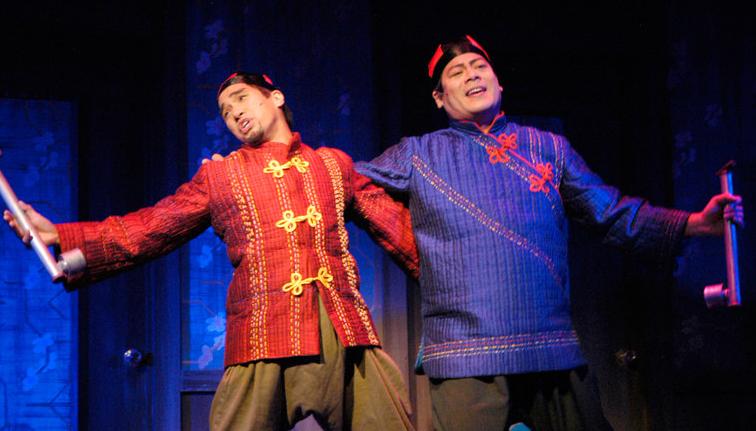
These are two basically good intentioned guys who have gotten mixed
up with the evil Mrs. Meers (played by a Caucasian woman with a chopstick in her hair who
speaks in a bad Japanese accent) who runs a white slavery operation, enlisting these two
guys to kidnap young girls who will be sent to China and sold into slavery. The guys
do it because they are trying to earn enough money to bring their mother over from Hong
Kong.
“We would never do anything anti-Jewish, or
anti-African-American. Blackface is unthinkable, but yellowface is utterly fine,”
said Newton resident Mia Wenjen, whose Pragmatic Mom blog brought attention to the debate,
reported the Boston Globe.
I guess my question is how far we take political correctness in our
more enlightened day and age. Do we stop new productions of South Pacific,
because the character of Bloody Mary, a Tonkinese woman who is willing to do whatever she
can to get her daughter a white husband might offend Pacific Islanders?
Do we refuse to let children read (or see a prouction about) Tom
Sawyer because the original Mark Twain painted an accurate picture of the time, including
the colloquial expressions for African Americans? Such a book would never be written
today, but it is a product of its time. For that matter, so is "Uncle Tom's
Cabin," which has the same problem of stereotypical characters. They are
stories of the history of this country.
Do we stop seeing The King and I because the Siamese king
has a harem and treats his wives as servants, including beating them for disciplinary
purposes?
How about West Side Story and the stereotypical Puerto
Ricans portrayed in that beloved classic? Or do we never watch The Producers,
which might be offensive to Jewish people?
(And to take matters to the extreme, now that we know that Germany is
one of our most treasured allies, do you continue to watch Sound of Music with
its stereotypical Nazis, or will that offend today's German-Americans?)
The article went on to list several shows that are problematic
because of racial stereotypes including, surprisingly, Flower Drum Song which has
an entire Chinese cast. How are they supposed to act, if not Chinese?
The protesting group thinks that these classic shows should be
rewritten, eliminating the offensive parts. But is that throwing out the baby with
the bathwater? Do we want to homogenize everything that we see on the stage? on
television? in the movies? Do we only allow characters that don't offend anybody to
be seen by our tiny tots? Do we thus whitewash our country's history as defined by its
musicals?
As I said at the outset, I am not an ethnic minority, so I can't
know, on a gut level how it feels to watch these characters portrayed on the stage. But
the middle-class, more than middle aged white woman feels that shows are a product of
their time and performing them as they were written, shows the times in which they were
written and is, in its way, a different way of teaching history.
